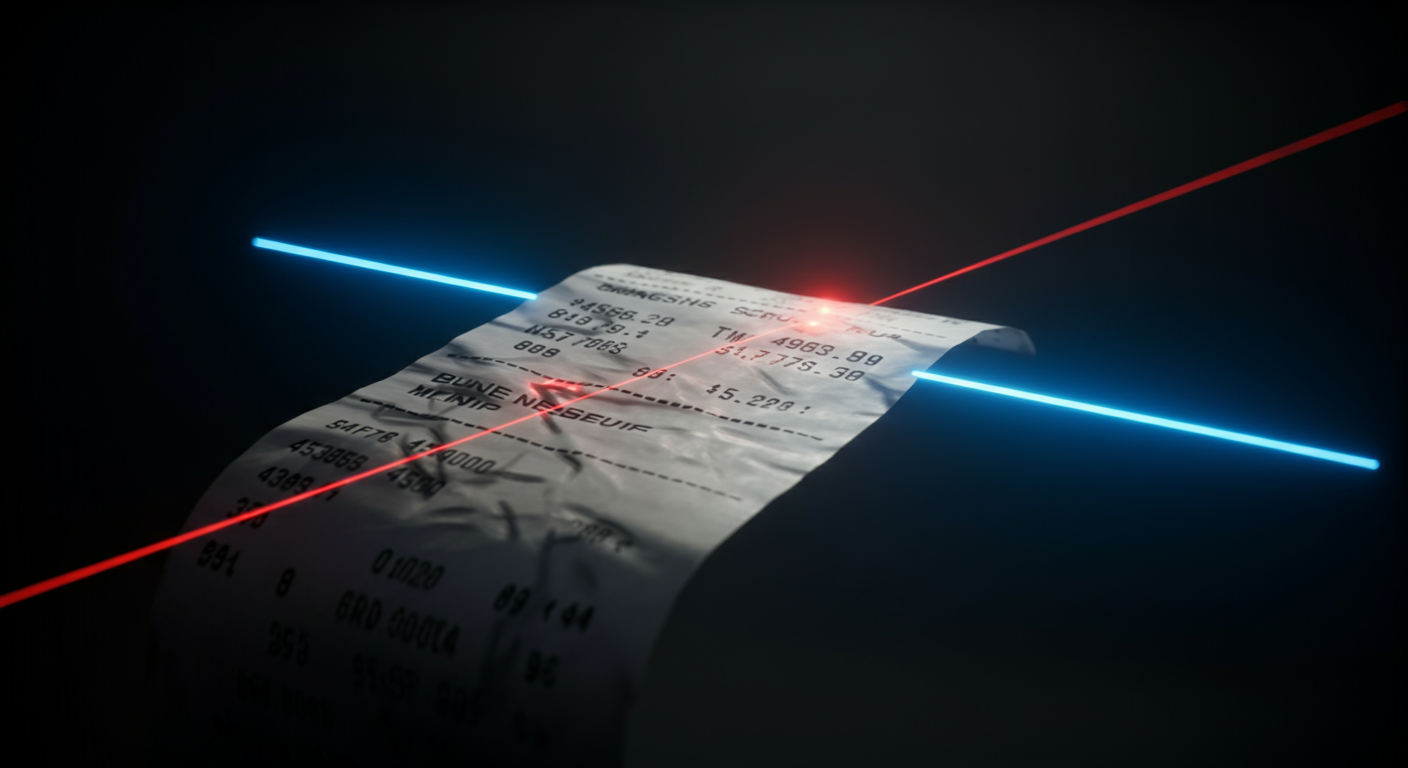
Stop trusting your "Red Flag" receipt scanner. It is lying to you.
According to the Association of Certified Fraud Examiners (ACFE), organizations lose 5% of annual revenue to fraud. But that number is a relic. The receipt you just approved wasn't scanned from a crumpled thermal printout at a rainy gas station. It was hallucinated by a neural network in a fraction of a second.
Legacy platforms like SAP Concur rely on Optical Character Recognition (OCR) to read pixels. They hunt for blurry fonts, mismatched dates, or bad cropping. But generative AI doesn't make clumsy mistakes. It creates mathematically perfect forgeries. We aren't talking about Photoshop. We are witnessing "Fraud-as-a-Service" bots generating unique metadata and flawless EXIF tags that bypass every standard Audit Trail.
Your expensive scanner sees a valid business expense. A forensic algorithm sees a deepfake. Here is why your finance team is losing the war against synthetic reality.
Why Expense Reimbursement Schemes Are Beating Your Scanner
The uncomfortable reality is that legacy OCR tools were engineered to digitize messy paper receipts, not to detect perfect digital forgeries. Your current tech stack reads pixels; it does not verify reality.
ð Key Takeaways
- Why Expense Reimbursement Schemes Are Beating Your Scanner
- The Fix: Level 3 Data and Oversight Systems
- Insider Moves Most People Miss
A mid-level manager can now prompt a specialized LLM to generate a unique, visually flawless receipt for a $400 client dinner that never happened. These aren't simple edits; they are synthetic assets. They bypass standard Duplicate Detection Algorithms because the AI generates a fresh image hash for every submission. The pixels are new, even if the fraud is old.
David Barrett, CEO of Expensify, has long argued for a shift toward "receipt-free" automation, where data flows directly from the merchant. He's right. Until that infrastructure is universal, reliance on image scanning invites Maverick Spend—off-contract purchases that look legitimate but bleed budgets dry. Standard scanners ingest the image text—"Steakhouse, $400"—and approve it because the math adds up. They miss the forensic truth because they aren't checking the source.
If your system relies on Natural Language Processing (NLP) alone to interpret context (e.g., knowing "The Library" is a bar, not a book supplier), you are still only analyzing the surface. You need to go deeper.
The Fix: Level 3 Data and Oversight Systems
Visual verification is dead. The only defense against synthetic receipts is data matching.
This is where Level 3 Data becomes the only metric that matters. Standard credit card data (Level 1 and 2) gives you the merchant name and total amount. Level 3 extracts line-item details—SKU, quantity, and unit cost—directly from the payment network. A scanner might see a valid receipt for "Office Supplies," but the Level 3 data reveals the SKU belongs to a PlayStation 5.
Platforms like Oversight Systems have moved beyond simple rule-matching. They use AI to monitor 100% of transactions autonomously, identifying patterns that human auditors miss. This isn't just about saving money; it's about the law. The Internal Revenue Service (IRS) requires expenses to be "ordinary and necessary." If you cannot prove the expense actually occurred because your proof is a generated image, you fail the test.
The Global Business Travel Association (GBTA) reports that nearly 19% of expense reports contain errors. Relying on manual review or basic OCR for T&E (Travel and Expense) is no longer a control; it's a liability. For public companies, this is a Sarbanes-Oxley (SOX) nightmare. You cannot certify internal controls when your evidence is synthetic.
A high-quality system also reduces False Positives. Nothing enrages a top-performing sales rep more than having a legitimate client dinner flagged as fraud. By matching the receipt image against the Level 3 bank data, you confirm the truth without the interrogation.
Insider Moves Most People Miss
Most expense policies were written for a world where "fake receipts" meant Photoshop and a steady hand. In 2026, GenAI generates visually flawless, unique receipts in seconds. Here is how you beat the algorithm.
ð Worth Noting: But that number is a relic
- Audit the EXIF, not just the pixels. GenAI creates perfect text but often fails the metadata test. Configure your scanner to flag any image where the "Camera Model" data is missing or conflicts with the employee's known device.
- Force Level 3 Data extraction. Stop relying on what the receipt says. Configure your corporate cards to pass Level 3 data and auto-reject any expense over $50 that doesn't match the bank's line-item detail.
- Kill the "Human-in-the-Loop" Fallacy. Humans are bad at spotting perfect fakes. If you are relying on an AP clerk to catch AI-generated fraud, you have already lost. Trust the hash, not your eyes.