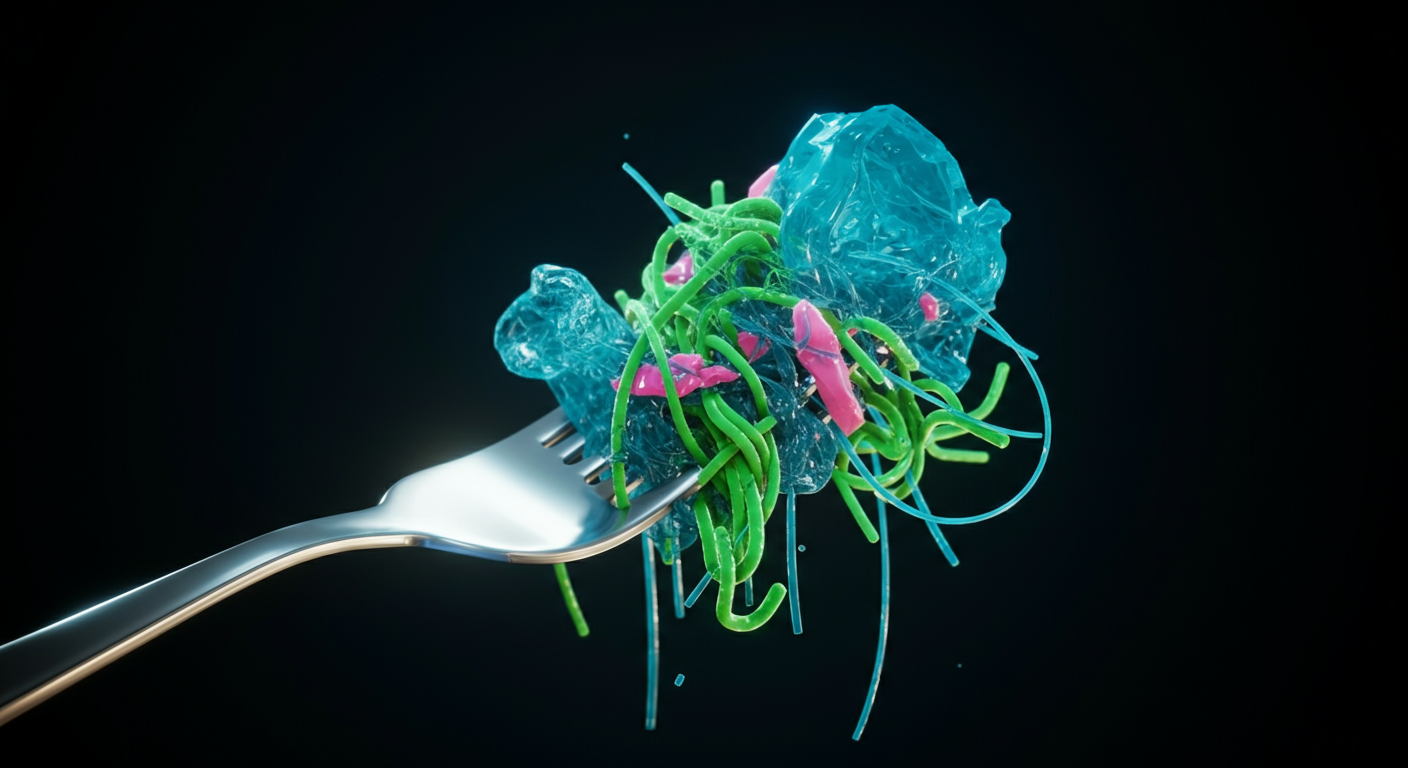
The Microplastic Ingestion Visualizer: Your "Credit Card" Score is Wrong
You’ve seen the viral infographic: a credit card sitting on a dinner plate. The caption usually screams that you eat 5 grams per week of plastic. That statistic, born from a 2019 University of Newcastle, Australia meta-analysis commissioned by the World Wide Fund for Nature (WWF), made for great headlines. Reuters Graphics turned it into "A Plate of Plastic," and the world panicked.
Seven years later, we know that metric is a comforting lie.
The "credit card" analogy fails because it measures mass, not toxicity. It assumes you are swallowing relatively large, inert chunks of Anthropogenic Debris that pass through your system like a swallowed button. The reality is far worse. You aren't just eating plastic; you are absorbing a "Nanoplastic Fog."
The 2019 data relied on optical microscopy and simple staining. If a particle was smaller than a speck of dust, the scientists literally couldn't see it. But thanks to the shift to Stimulated Raman Scattering (SRS) microscopy, we now know those early calculators missed 90% of your intake.
We rebuilt the algorithm. The new Visualizer doesn't just weigh the plastic; it tracks the millions of invisible Nanoplastics that cross your placenta and lodge in your brain.
ð Key Takeaways
- The SRS Shift: Why the Math Broke
- Beyond the Gut: Bio-Translocation
- Insider Moves Most People Miss
The SRS Shift: Why the Math Broke
For years, the "Source of Truth" was that 5-gram figure. It relied on standard optical detection or Micro-Raman Spectroscopy, which hits a hard floor at roughly 1 micrometer. It missed the fog entirely.
The 2026 standard pivots to SRS. Unlike previous methods that required messy staining or slow thermal detection, SRS fires two synchronized lasers at a sample. The interference pattern vibrates specific molecular bonds, identifying plastic types in microseconds.
This precision destroys the old math. A landmark January 2024 Columbia University study using SRS revealed that bottled water contains roughly 240,000 fragments per liter—100 times higher than the 2019 estimates.
Dr. Sherri Mason, Sustainability Coordinator at Penn State Behrend, put it bluntly when the data dropped: "We focused entirely on the weight of the plastic for a decade. We should have been counting the millions of microscopic shards piercing our cells."
Beyond the Gut: Bio-Translocation
The "credit card" analogy implies an inert mass passing through the gut. It suggests you poop it out. SRS imaging proves we are dealing with a mist of nanoplastics capable of Bio-Translocation—crossing the intestinal wall into the bloodstream.
Modern ingestion algorithms now process exposure in three vectors:
1. Inhalation vs. Ingestion
You breathe more plastic than you eat. Our updated model weighs airborne synthetic fibers from carpets and fast fashion. If you live in a home with polyester carpets and wear fleece, your lungs are a primary entry point for Polyethylene Terephthalate (PET) dust.
2. Chemical Leaching (The Hidden Load)
Plastic isn't just physical debris; it's a chemical delivery system. The Visualizer calculates the release of Bisphenol A (BPA) and Endocrine Disrupting Chemicals (EDCs) based on your heating habits. Microwaving a "microwave-safe" container? You just spiked your score.
3. Trophic Transfer
We track accumulation up the food chain. Plankton eat the plastic; shellfish eat the plankton; you eat the shellfish. This Trophic Transfer concentrates toxins in seafood, making a plate of oysters a high-risk event for nanoplastic consumption.
Insider Moves Most People Miss
Most advice focuses on recycling. That helps the planet later, but it doesn't stop the plastic entering your blood today. Here is how to reduce your personal intake score immediately.
- Upgrade to Reverse Osmosis (RO).
Standard carbon pitchers (like Brita) are useless against the "Nanoplastic Fog." While early studies by Dr. Thava Palanisami tracked larger fragments, recent SRS data shows millions of nanoplastics slip right through standard carbon blocks. You need an RO system to physically block particles at the molecular level. - The "Glass-Only" Heat Rule.
Never heat plastic. Ever. Even "BPA-Free" plastics release estrogenic chemicals when heated. If you microwave leftovers, transfer them to glass or ceramic first. It is the single biggest reduction you can make to your chemical load.
ð Worth Noting: It assumes you are swallowing relatively large, inert chunks of Anthropogenic Debris that pass through your system like a swallowed button