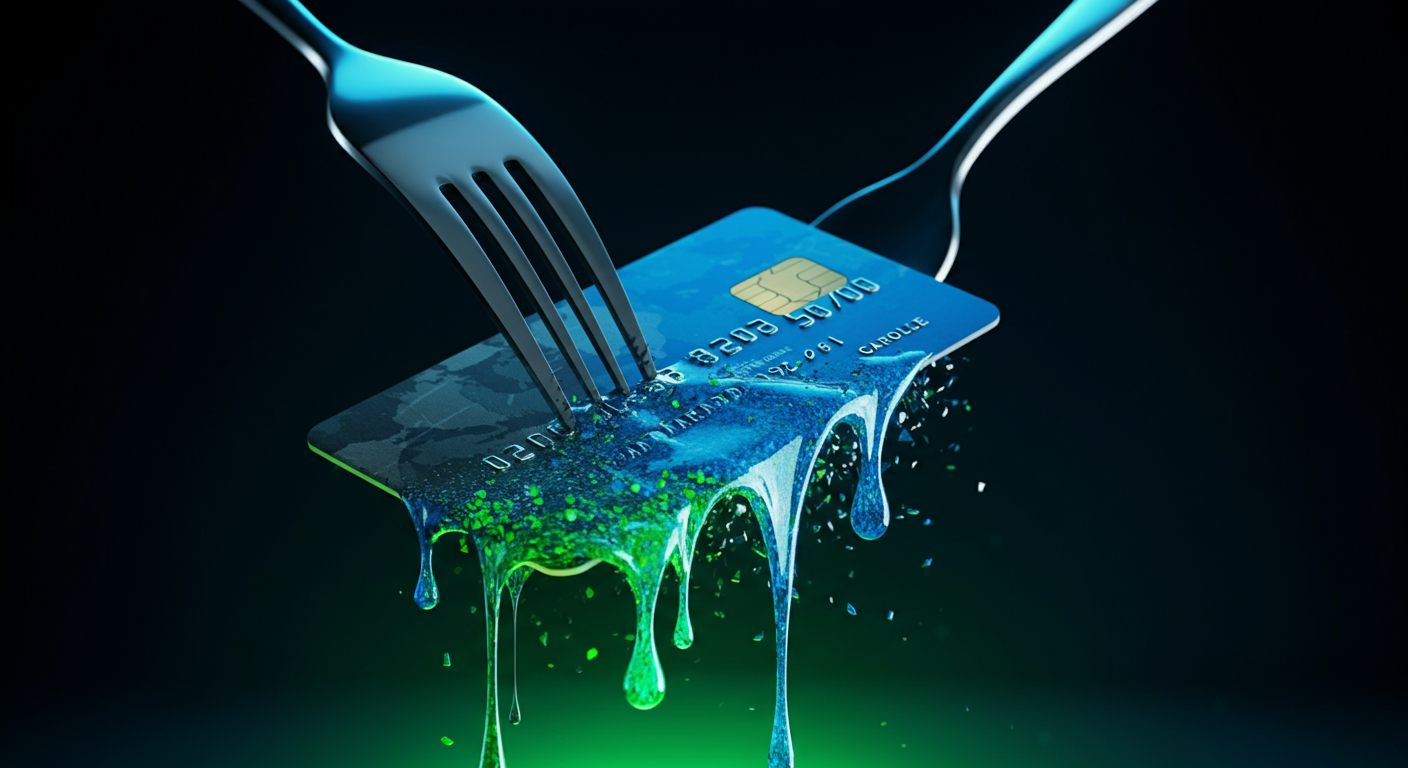
The internet loves a simple panic. In 2019, the World Wildlife Fund (WWF) handed the media a perfect viral grenade: the image of a credit card resting on a dinner plate. Based on analysis by Dr. Thava Palanisami at the University of Newcastle, the headline claimed the average human ingests 5 grams of plastic every week.
It was a masterclass in marketing. Your Plastic Diet, the interactive tool that followed, cemented the "5 grams" benchmark in the public consciousness. But as a toxicological model, it is dangerously flawed.
Here is the ugly truth the viral infographics miss: Mass is a red herring. Your digestive system can pass a smooth, 5-gram LEGO brick with relative ease. It cannot, however, easily expel millions of jagged nanoplastics that possess enough surface area to leach chemicals directly into your blood. By obsessing over the weight of the plastic, we are ignoring the real threat: the "Trojan Horse" effect of particles small enough to breach biological barriers.
We need to stop weighing plastic and start counting vectors. The old visualizers are obsolete because they treat all polymers as inert roughage. They aren't.
The Credit Card Fallacy: Why Mass Is the Wrong Metric
ð Key Takeaways
- Beyond Visual Counting: The Science of Detection
- The "Whole Organism" Variable
- The Cynic’s Guide to Reduction
ð Key Takeaways
- Beyond Visual Counting: The Science of Detection
- The "Whole Organism" Variable
- The Cynic’s Guide to Reduction
The "credit card" statistic persists because it is tangible. It gives the brain something to latch onto. However, relying on the 2019 WWF study to measure risk creates a scientific blind spot. While the study was excellent for raising awareness, it fails to account for the "Surface Area Paradox."
In toxicology, surface area drives toxicity. Grind a single credit card into billions of microscopic shards, and the available surface area for chemical leaching explodes. A solid piece of PVC is a choking hazard; a cloud of PVC dust is a chemical weapon. The standard Microplastic Consumption Visualizer implies that volume is the enemy, but the real threat is particle count and size.
Kieran Cox from the University of Victoria provided a more nuanced dataset, estimating that Americans ingest between 74,000 to 121,000 particles annually, depending on age and sex. Crucially, Cox highlighted that inhalation—not just ingestion—plays a massive role. The "credit card" model ignores the air you breathe entirely.
These particles act as "Toxicity Vectors." They don't just pass through; they carry hydrophobic pollutants and Endocrine Disruptors. Once inside, they undergo bioaccumulation—building up in tissue rather than exiting via the toilet. The hard truth isn't that you are eating plastic; it's that you are absorbing the chemical additives coating it.
Beyond Visual Counting: The Science of Detection
Most online calculators are guessing. They rely on visual counting methods that are prone to error. To get a real number, you can't just look through a microscope; you need to analyze the chemical signature.
The gold standard isn't a pair of eyes—it's FTIR Spectroscopy (Fourier-transform infrared spectroscopy). This method shoots infrared light at particles to identify the specific polymer type (PET vs. PVC), distinguishing actual plastic from sand or organic matter. Without FTIR, or at least Nile Red Staining—which makes plastics fluorescent under blue light—data is often just noise.
Reuters Graphics attempted to bridge this gap with their "A Plateful of Plastic" project. While visually stunning and far superior to the generic calculators, even they are forced to rely on mass estimates because the data on nanoplastic toxicity is still catching up. We can count the big pieces. The small ones—the ones that cross the blood-brain barrier—remain largely invisible to standard consumer tools.
The "Whole Organism" Variable
If you eat shellfish, your data is wrong. Most visualizers apply a flat global average, but diet changes the math entirely. This is due to Trophic Transfer. When you eat a fish fillet, the gut (where plastic accumulates) is usually removed. When you eat an oyster or a mussel, you eat the whole organism—plastic gut and all.
ð Worth Noting: But as a toxicological model, it is dangerously flawed
Then there is the water variable. Dr. Sherri Mason, a leading voice on freshwater plastic pollution, found that bottled water contains roughly double the microplastic count of tap water. If your "visualizer" doesn't ask if you drink bottled water, it's useless.
The World Health Organization (WHO) has called for more research, but the early signals are clear: single-use plastics are degrading into our food chain faster than we can measure them.
The Cynic’s Guide to Reduction
- The Water Filter Trap. Most "brita-style" pitcher filters are cosmetic. They remove chlorine taste but let nanoplastics pass right through. To actually catch particles <10μm, you need Reverse Osmosis or a sub-micron block. Anything less is security theater.
- The Salt Mine Solution. Orb Media blew the lid off tap water, but the salt data is arguably worse. A study involving National Geographic found that 90% of table salt brands globally contain microplastics. Sea salt is essentially dehydrated ocean pollution. Switch to mined ancient salts (from deposits formed before 1950) to cut this vector.
- Ignore the "Credit Card." Stop worrying about the weight. Worry about the polymer type. Eating 1g of inert Polypropylene is likely safer than breathing 1mg of PVC dust. Toxicity isn't heavy; it's chemically active.