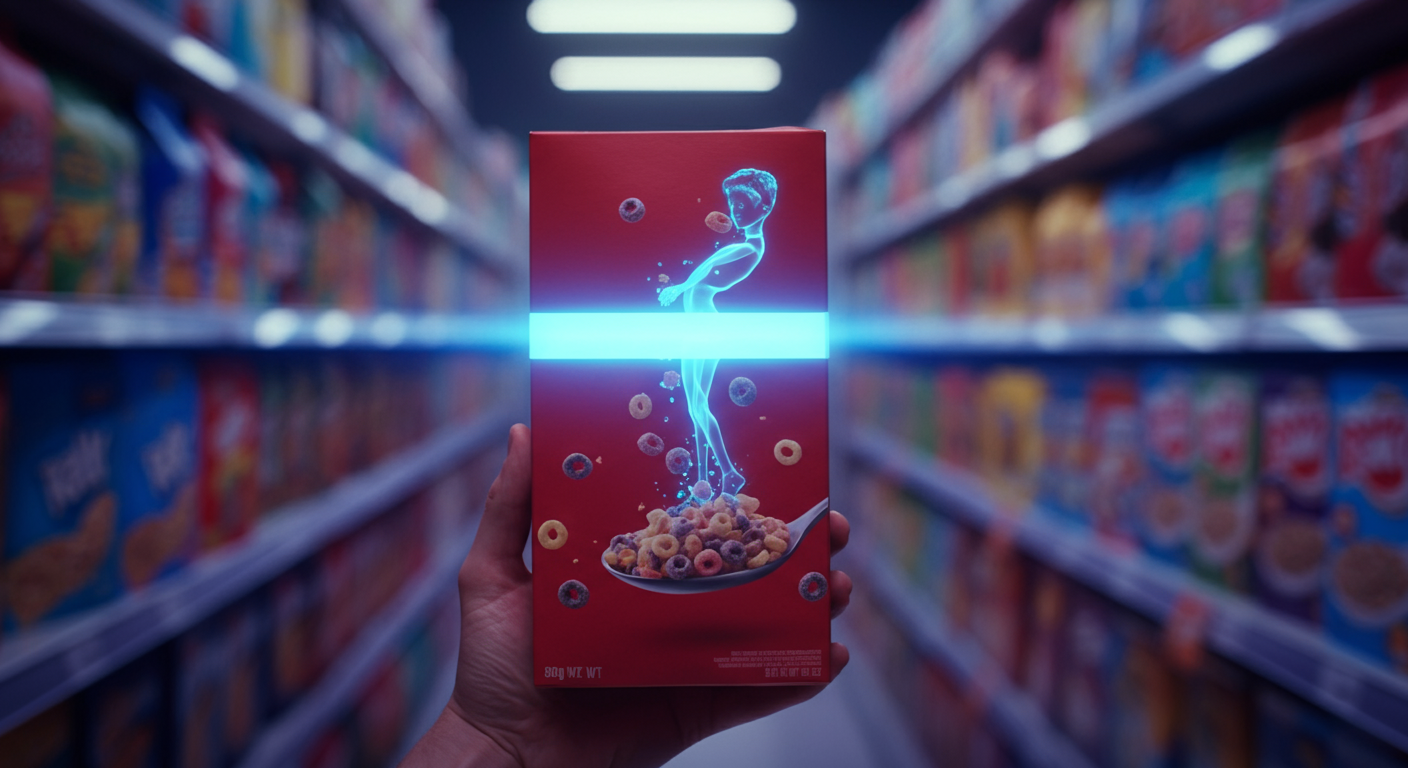
Upload your receipt. That pit in your stomach isn’t nostalgia—it’s the realization that you are the victim of a calculated extraction.
In 1990, Kevin McCallister bought a cart of basics in Home Alone for $19.83. Today, that same "Home Alone" Shopping List costs over $68.00. That is a nearly 243% increase, far outpacing the official inflation calculators. While the Bureau of Labor Statistics (BLS) claims the Food-at-Home Index has cooled, your bank account tells a different story. This disconnect is the "Grocery Gaslight."
The Washington Post confirms a 25.8% grocery price increase between 2020 and 2024 alone. But looking at supply chains or "Greedflation" only solves half the puzzle. The other half is sitting in your pocket.
That $8.99 box of cereal isn't expensive because of a bad wheat harvest. It’s expensive because you didn't scan a QR code. We have entered the era of the "Compliance Tax"—a hostile pricing structure where the shelf price is a penalty fine for protecting your privacy.
The Retail Media Pivot: The 'Grocery Store' is Dead
Stop blaming the boat stuck in the Suez Canal. The container ships docked years ago. The reality is that your supermarket is no longer a food merchant; it is an ad-tech platform disguised as a grocer.
ð Key Takeaways
- The Retail Media Pivot: The 'Grocery Store' is Dead
- Calculating the Compliance Tax
- The Economic Loop: Why Prices Won't Drop
- Friction Fatigue and the Dark Pattern
- The Socio-Economic Impact Map
Industry giants like Kroger / Albertsons have fundamentally altered their business models. They realized that selling milk has razor-thin margins (often 1-3%), but selling you has margins upwards of 70%. This is the Retail Media Pivot.
Stores have shifted to a "Retail Media Network" (RMN) model. They collect your behavioral data—what you buy, when you buy it, and what coupons you ignore—and sell that profile to CPG conglomerates like Nestlé or PepsiCo. In this ecosystem, the grocery store is just the physical interface for data extraction.
This creates a perverse incentive: keep the "Analog Shelf Price" painfully high to force shoppers into the app. The discount isn't a gift. It is a data transaction payout.
Calculating the Compliance Tax
How much does it cost to keep your data private? We can finally quantify the "Gaslight."
Consider a standard basket of 20 household staples. At the "Analog Shelf Price"—the price you pay if you walk in, grab goods, and pay cash—the total rings up to $145.50. However, if you spend 15 minutes engaging with the store's app, clipping "Just for U" digital coupons, and scanning your loyalty barcode, that same basket drops to $112.00.
The $33.50 difference is not savings. It is a Compliance Tax charged to anyone who refuses to participate in the surveillance economy. If you don't feed the algorithm, you don't get the subsidy. You aren't paying for the eggs; you're paying a fine for anonymity.
The Economic Loop: Why Prices Won't Drop
Economist Isabella Weber famously coined the term "Seller’s Inflation," arguing that corporations used the cover of pandemic confusion to hike prices simply because they could. While she is right about profit margins, the mechanism has evolved.
Today, the pricing strategy is less about raw margin and more about the RMN Subsidy Model:
- The Anchor Price: The retailer sets a high base price (e.g., $8.99 for cereal). This price exists primarily to make the app price look attractive.
- The Data Gate: To access the "real" market price ($4.99), the shopper must generate metadata via the app.
- The Ad Subsidy: Brands pay the retailer for access to this audience segment via the Retail Media Network.
- The Kickback: The retailer uses a fraction of that ad revenue to "subsidize" the discount for the user.
This explains why the Wayback Machine shows grocery circulars from 2019 with simple, flat sales ("2 for $5"), whereas today's circulars are a maze of "Must Buy 5," "Digital Coupon Only," and "Limit 1" restrictions. The friction is the point.
ð Worth Noting: But looking at supply chains or "Greedflation" only solves half the puzzle
Friction Fatigue and the Dark Pattern
Have you ever tried to use a digital coupon only to find the app won't load inside the store's concrete walls? Or realized at the checkout that you "clipped" the wrong variety of yogurt?
This is "Friction Fatigue" by design. Retailers employ UX "Dark Patterns" to make coupon redemption difficult. They want you to sign up (surrendering your data) but fail to redeem the discount (paying the full price). It’s a win-win for the house. You provide the tracking ID, but you still pay the Compliance Tax because the app interface was too clunky to navigate in the checkout line.
The Socio-Economic Impact Map
The "Grocery Gaslight" isn't just annoying; it's discriminatory. The Compliance Tax disproportionately targets two specific groups:
- The Unbanked & Low Income: Accessing "Digital Shelf Prices" requires a smartphone, a data plan, and the time to sort through apps. Those relying on SNAP benefits or cash often lack the digital infrastructure to avoid the tax.
- The Elderly: Older generations who struggle with app interfaces are systematically charged the highest prices in the store. They are paying a premium for their inability to interface with ad-tech.
Former Labor Secretary Robert Reich frequently warns about the dangers of corporate monopolies. In the grocery sector, consolidation allows chains to set these two-tier pricing structures without fear of competition. When Kroger and Albertsons control the market, you can't just "go somewhere else" to avoid the data harvest.
The Illusion of Value: Skimpflation and Hedonics
Even when you pay the "Compliance Tax" and get the lower price, you are often getting less.
We all know Shrinkflation—the 16oz bag becoming 14oz. But the more insidious tactic is Skimpflation. This is where the price and weight stay the same, but the ingredients degrade. Manufacturers swap sunflower oil for palm oil, or reduce the cocoa content in chocolate, effectively lowering the value of the product while the sticker price remains static.
Why doesn't the BLS catch this? Because of Hedonic Quality Adjustment. The BLS adjusts inflation data based on "quality improvements." If a TV gets better, they say the price "dropped" relative to value. But they rarely adjust for food getting worse. The official data assumes your chocolate chip cookie is the same as it was in 2019. Your taste buds know better.
You can verify this divergence yourself. Go to FRED (Federal Reserve Economic Data) and overlay the graph of Corporate Profits after Tax against the Consumer Price Index. The lines diverge sharply post-2020. The gap between those lines is the gaslight.
Insider Moves to Beat the 'Compliance Tax'
- Audit the Unit Price, Not the Sticker. Manufacturers rely on you scanning the $5.99 tag without noticing the box silently dropped from 16oz to 12oz. Always calculate cost-per-ounce to spot Shrinkflation. If the unit price spikes while the sticker price stays flat, you are paying more for less.
- Burner Data Strategy. If you must use the app to avoid the price gouge, do not give them your real life. Create a dedicated "spam" email address and use a VOIP number (like Google Voice) for loyalty accounts. Feed the Retail Media Network junk data while taking their subsidized prices.
- Watch for 'Dynamic Pricing'. Electronic Shelf Labels (ESLs) are becoming standard. These allow stores to change prices instantly—potentially introducing surge pricing during peak hours (5 PM - 7 PM). If you see digital tags, double-check the price at the register. The price on the shelf at 5:00 PM might not be the price in the system at 5:15 PM.
- Trust the Groundwork Collaborative. For real analysis on supply chain vs. corporate greed, follow reports from the Groundwork Collaborative. They track the earnings calls where executives admit to keeping prices high to satisfy shareholders, debunking the "inflation made me do it" excuse.