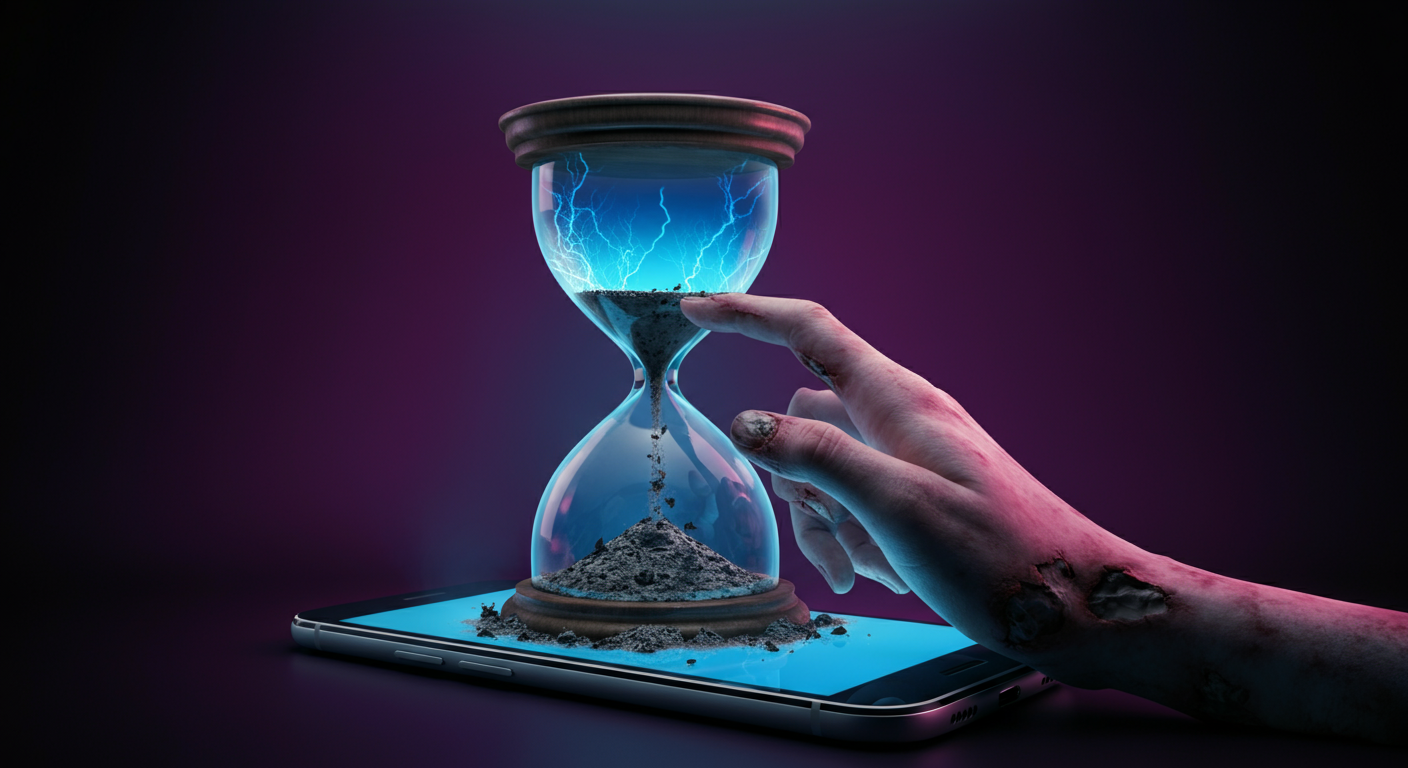
The 'Doom-Scroll' Mortality Clock
Let’s do the math. It is ugly, but we need to see it.
If you are 30 years old today, you have roughly 440,000 hours of life remaining. According to 2024 Global Web Index (GWI) data, the average user now spends 2 hours and 24 minutes daily on social platforms. Run that projection out to the grave, and the result is terrifying: you are scheduled to spend nearly six full years of your remaining existence staring at a 6-inch glass rectangle.
But that calculation is flawed. It assumes those years are just "time spent." It assumes the cost is merely lost productivity or a bit of "eye strain."
It isn't. That calculation fails to account for the Epigenetic Tax.
While tech journalists write endless think-pieces about "digital detoxes" for your mental health, longevity researchers are uncovering a much more aggressive reality. Doomscrolling doesn't just waste your time; it accelerates your biological decay. We aren't talking about metaphorically "feeling old." We are talking about Horvath’s Clock—the epigenetic biomarkers that measure how fast you are dying.
The Biology of "Revenge Bedtime"
The term "doomscrolling" was popularized by finance reporter Karen K. Ho in 2020, who tweeted nightly reminders to stop consuming catastrophe and go to sleep. She identified the behavior, but she couldn't have known the physiological price tag attached to it.
ð Key Takeaways
- The Biology of "Revenge Bedtime"
- Telomeres: The Fuse is Burning
- The Mortality Calculation
- Stop the Clock: 3 Moves to Break the Loop
Most of us engage in what psychologists call Revenge Bedtime Procrastination. It’s a rebellion against a workday that stole your autonomy. You stay up late to reclaim your time, scrolling through feeds to feel connected. But biologically, you are entering a war zone.
When you engage with the Infinite Scroll—a UI pattern weaponized by Aza Raskin and perfected by TikTok—you remove the "stopping cues" that human brains rely on. Without a chapter break or a closing door, the brain enters a loop.
Here is where the aging begins. Your brain is hardwired with a Negativity Bias. Evolutionarily, paying attention to a predator (negative stimuli) was more important than noticing a flower (positive stimuli). Algorithms exploit this by feeding you high-arousal, negative content. This triggers the HPA Axis (Hypothalamic-Pituitary-Adrenal).
Every time you see a riot, a market crash, or a "hot take" designed to enrage you, your HPA axis drips cortisol into your bloodstream. In nature, cortisol is for sprinting away from a lion. In bed, at 11:30 PM, it has nowhere to go. It sits in your tissue. This state of unresolved agitation keeps your sympathetic nervous system red-lined, preventing the "rest and digest" parasympathetic state required for cellular repair.
Telomeres: The Fuse is Burning
This chronic chemical bath leads to what longevity science calls "inflammaging." The constant presence of cortisol and the lack of deep restorative sleep directly attacks your telomeres.
Think of telomeres as the plastic aglets at the end of a shoelace (your DNA). They keep the genetic code from fraying. Every time your cells divide, telomeres get shorter. When they get too short, the cell becomes senescent—it turns into a "zombie cell" that pumps out inflammatory factors and refuses to die. This is the fundamental mechanism of aging.
Chronic stress from the "Mean World Syndrome"—George Gerbner’s theory that heavy media consumers believe the world is more dangerous than it actually is—accelerates this shortening. You are effectively trading the structural integrity of your DNA for a dopamine hit.
"The smartphone is the modern hypodermic needle, delivering digital dopamine 24/7 for a wired generation." — Dr. Anna Lembke, author of Dopamine Nation
Dr. Lembke’s work highlights the addiction mechanics, but the physical toll is mitochondrial. The blue light from your screen suppresses melatonin, which does more than regulate sleep; it is a potent antioxidant that protects your mitochondria. By blasting your retinas with blue light while spiking your cortisol with rage-bait, you are disrupting energy production at the cellular level.
ð Worth Noting: It is ugly, but we need to see it
The Mortality Calculation
So, what is the real cost? It’s not just the 2 hours and 24 minutes a day.
If we apply the principles of the Horvath Clock to sedentary, high-stress behavior, we can estimate a multiplier effect. An hour of doomscrolling is not equal to an hour of reading a book. The combination of sedentary posture, blue light toxicity, and cortisol spiking makes it biologically expensive.
Tristan Harris and the Center for Humane Technology often discuss the "ledger of harms," focusing on democracy and attention spans. We need to add a line item for longevity. If you spend 2 hours a day doomscrolling, you aren't just losing 2 hours. You are likely aging your cardiovascular and cellular systems at a rate faster than chronological time.
You are paying an Epigenetic Tax for the privilege of being angry at strangers.
Stop the Clock: 3 Moves to Break the Loop
- The Grayscale Nuke. Go to Accessibility Settings > Display > Color Filters. Turn your phone Black and White. Silicon Valley engineers use "slot machine" colors (bright reds and oranges) to trigger your Intermittent Variable Rewards system. Grayscale kills the visual dopamine instantly. Your phone becomes a tool, not a toy.
- Add "Friction." Willpower is a myth; design is reality. Install One Sec or Opal. These apps force a 10-second pause before social media opens. That tiny gap is often enough for your prefrontal cortex to override the lizard brain and ask, "Do I actually want to do this?"
- Audit Your "Digital Wellbeing." Check your Screen Time API data. Look at the "Pickups" stat. If you are picking up your phone 80+ times a day, your HPA axis never gets a break. Set a hard limit: No screens 60 minutes before bed. This isn't about "wellness"; it's about protecting your mitochondria.
""The smartphone is the modern hypodermic needle, delivering digital dopamine 24/7 for a wired generation." — Dr. Anna Lembke, author of Dopamine Nation"
The algorithms are designed to win. They have supercomputers predicting your next move. You have a tired brain seeking relief. The only way to win is to refuse to play. Your cells are counting on it.