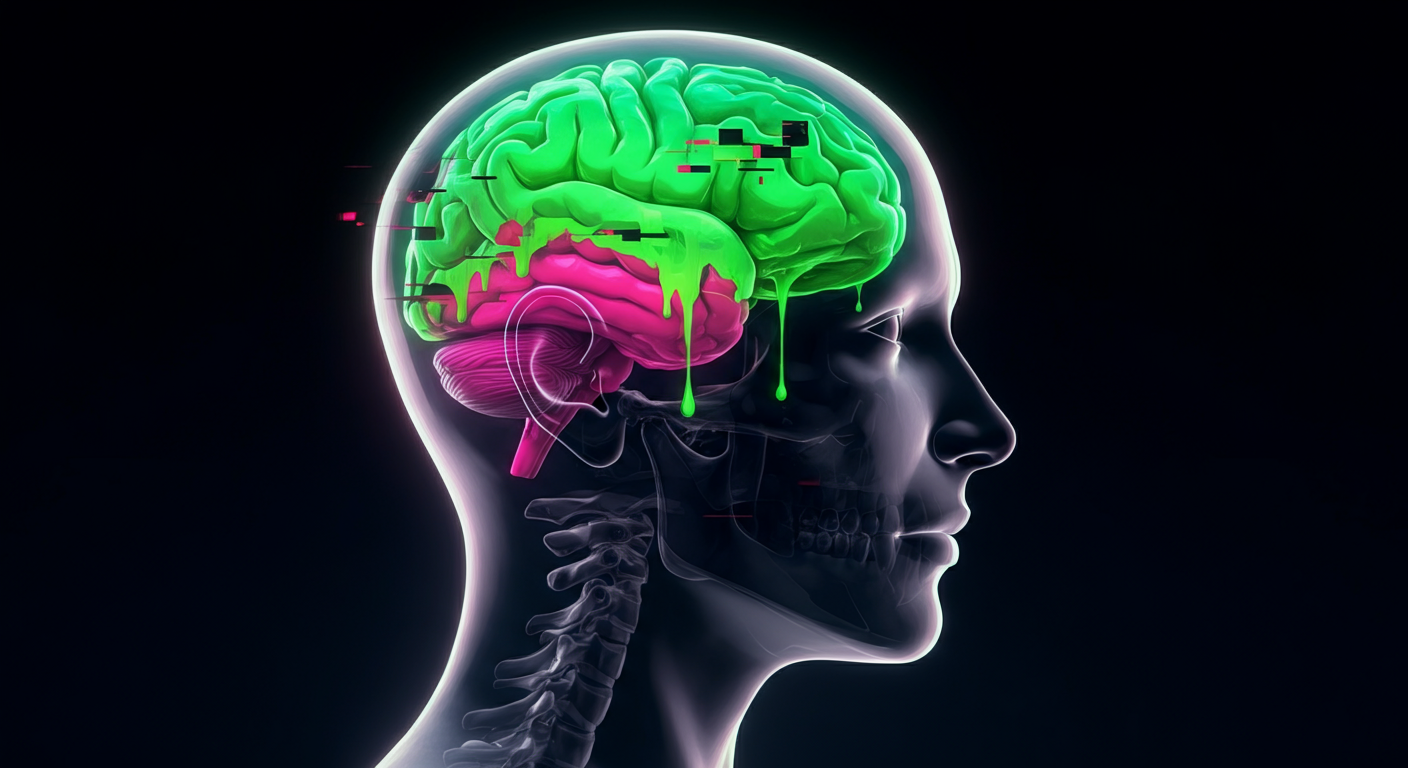
If "Fanum Tax" sounds like an IRS form to you, you’re cooked. But don't feel bad. Linguist Gretchen McCulloch argues that your confusion isn't a bug—it’s a feature. We aren't watching a generation lose their minds; we are watching them build a fortress.
While the internet mocks Gen Alpha for "brainrot," these kids are accidentally building a Semantic Firewall. By the time ChatGPT figures out how to use "Rizz" in a sentence, the TikTok hive mind has already moved on to "Sigma," leaving the AI—and the marketers who rely on it—holding a bag of outdated cringe.
This is the 'Brainrot' Fluency Test. It doesn't measure your vocabulary; it measures your humanity. In an era of Dead Internet Theory, speaking nonsense is the only way to prove you aren't a bot.
Are you a human or a hallucination? Let's check your score.
The Hard Truth: It’s Not Rot, It’s Encryption
Stop rolling your eyes at "Skibidi Toilet." You aren't looking at a literacy crisis; you are watching a live-fire exercise in adversarial encryption. Most critics miss the obvious: this slang is a defense mechanism against the scraping that powers modern capital.
ð Key Takeaways
- The Hard Truth: It’s Not Rot, It’s Encryption
- Adversarial Linguistics: How the Trap Works
- Insider Moves Most People Miss
The logic is simple. Pew Research Center notes that 95% of teens have smartphone access. That isn't just a stat about screen time; it’s the infrastructure for a linguistic network that updates faster than any server farm. The moment a term is syntactically mapped by a neural network or added to the Oxford University Press dictionary, the youth cohort hits the "Cringe Kill-Switch."
They weaponize semantic shift to burn their own vocabulary the second it gets compromised by adults or algorithms.
"We are looking at a linguistic arms race. The speed at which slang mutates—from inception on a Kai Cenat stream to 'dead' status—is now faster than the training cycle of GPT-5. It’s not gibberish; it’s a biological CAPTCHA."
— Adam Aleksic (The Etymology Nerd)
If you—or a brand's Twitter bot—can understand the slang, the slang is already dead. The value is in the encryption, not the definition. By the time a marketing team briefs their copywriters, the target demographic has migrated to a new, unintelligible dialect. Your confusion is the security feature.
Adversarial Linguistics: How the Trap Works
Dismissing this lexicon as "brainrot" ignores its function. It acts as a constantly shifting key that separates the "chronically online" from the algorithmic scrapers. While AI models parse standard English with perfect syntax, they choke on slang that relies on layers of irony and audio cues.
Know Your Meme tracks these cycles, showing how terms now rise and fall in weeks rather than years. It’s a game of keep-away. Gen Alpha isn't just inventing words; they are engaging in adversarial attacks against the models trained to sell them things.
The lifecycle of "brainrot" follows a specific pattern designed to break predictive text:
- Genesis: A term spawns in a high-velocity environment, often a specific Kai Cenat clip or a short-form content edit, relying on a dopamine feedback loop of rapid cuts and loud audio.
- Saturation: Usage peaks. It becomes a shibboleth—a password proving you have high algorithm literacy.
- Detection: Brands and bots scrape the term. Wendy's uses "Rizz" in a tweet.
- Abandonment: The generation tags the term as "cringe." The AI's training data is now permanently poisoned with outdated slang.
This speed creates a "knowledge gap" that AI cannot cross. While Common Sense Media warns about the effects of this consumption on attention spans, there is a distinct upside: verification. In a comment section filled with bots, "brainrot" is the only content that passes the Dead Internet verification test.
If a comment reads like a perfectly structured sentence, it’s probably a bot. If it reads like specific, chaotic nonsense, it’s a human. We have reached the point where incoherence is the only proof of life.
ð Worth Noting: But don't feel bad
Insider Moves Most People Miss
- Weaponize the "LLM Lag." If ChatGPT can define a slang term in your draft copy, cut it. AI models train on historical data. If the bot knows the word, that word is already radioactive to Gen Alpha. Use AI to check what not to say.
- Test for "Algorithm Literacy," not vocab. When hiring social leads, don't ask them to define "Fanum Tax." Ask them to map the lifecycle of the trend. You need a strategist who understands why a term hits the kill-switch, not just someone who memorized a listicle.
- Use "Brainrot" as a biological CAPTCHA. Suspect a user in your community forum is a bot? Drop a context-heavy reference. Bots hallucinate meaning; humans recognize the vibe.