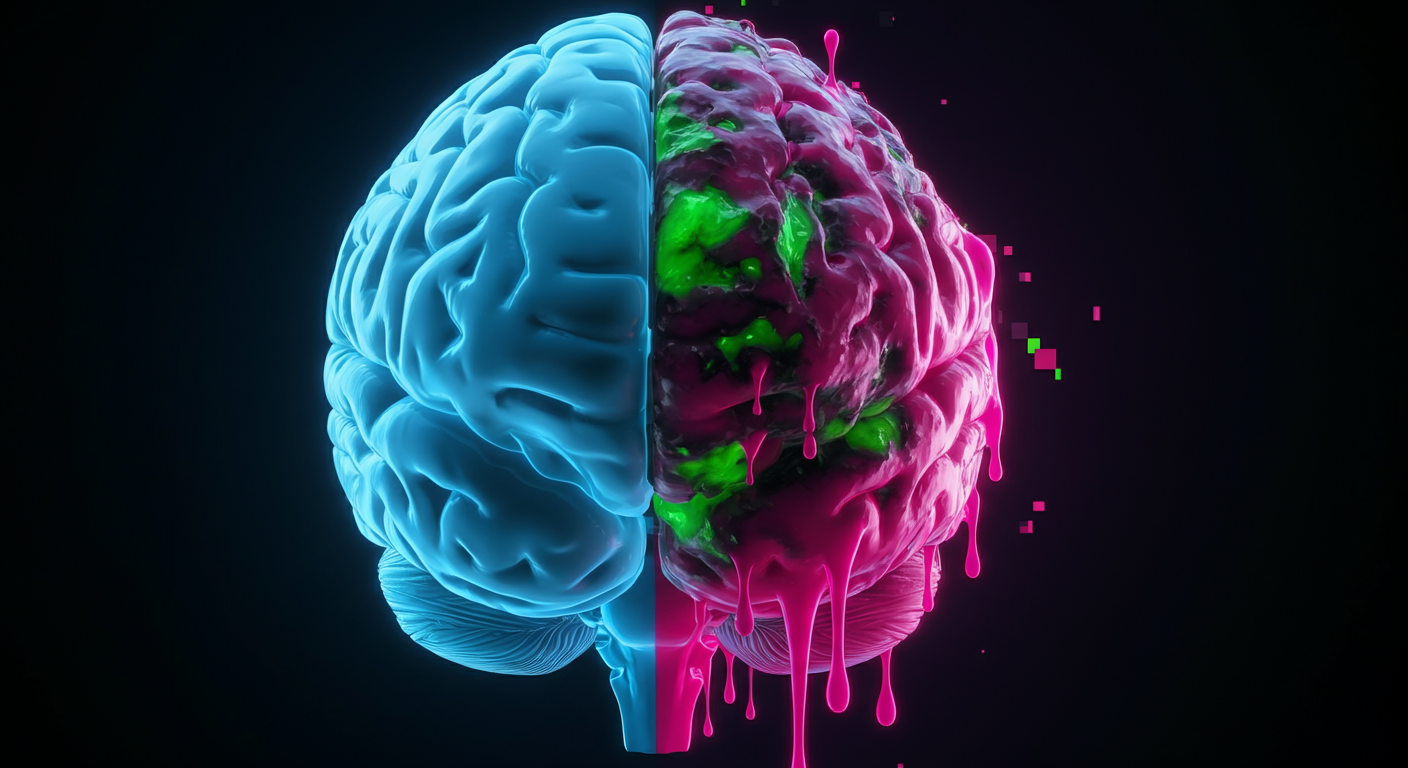
Your driver’s license claims you’re 29. But if we measured your age by the state of your dopamine receptors, you might be pushing 75.
While tech centimillionaires like Bryan Johnson spend millions reversing their epigenetic clocks, the rest of us are warping a different kind of timeline on TikTok. We call it "Brain Rot." It feels like cognitive decay. It isn't.
What looks like attention deficit to a previous generation is actually a high-performance filter for digital chaos. I ran my own habits through the new Bio-Age Calculator expecting a lecture. Instead, I found a paradoxical metric: the "Hyper-Associative Index." Your brain isn't breaking; it’s overclocking its visual cortex to survive a data stream that moves faster than biology intended.
But running an engine at redline burns fuel. Here is what your "Dopamine Age" actually reveals about your future health—and why you need to stop apologizing for your scrolling habits.
The Neuro-Plasticity Paradox: Adaptation, Not Atrophy
Viral filters frame "brain rot" as stupidity, but the underlying wiring is far more complex. It is aggressive, high-velocity adaptation. Steve Horvath created the gold standard for measuring aging using Epigenetic Methylation—chemical tags on your DNA. But this new "Dopamine Age" calculator assesses the structural reconfiguration of the Prefrontal Cortex caused by chronic hyper-stimulation.
ð Key Takeaways
- The Neuro-Plasticity Paradox: Adaptation, Not Atrophy
- Insider Moves Most People Miss
The brain treats the relentless stream of short-form content not as noise, but as a survival threat requiring rapid pattern recognition. To cope, it reallocates resources from deep storage (memory) to rapid indexing (search). We are witnessing a shift toward "Hyper-Associative Indexing." The brain stops storing data and starts storing pointers to data. It’s an efficient caching strategy for a world where information expires in minutes.
This re-wiring comes at a biological cost. The anxiety induced by doomscrolling spikes Cortisol, increasing Allostatic Load—the cumulative wear and tear on the body. A biologically accurate "Brain Rot" calculator processes three specific variables to determine your score:
- Visual Cortex Velocity: Measures the brain's ability to process non-linear visual narratives. High consumption creates a "Chaos Tolerance" that makes the real world feel agonizingly slow.
- Dopaminergic Resistance: Dr. Andrew Huberman frequently discusses how dopamine stacking creates a deficit. Constant spikes from TikTok or Reels downregulate dopamine receptors. You need louder, brighter, faster content just to reach baseline focus.
- Context Switching Cost: Calculates the metabolic energy required to shift focus. Microsoft’s 2015 data pegged attention spans at 8 seconds; newer models suggest high-frequency users struggle to engage Cognitive Reserve for tasks longer than 3 minutes.
If you want to know if you are dying on a cellular level, go to InsideTracker for a blood panel to check your GrimAge or PhenoAge. Those are clinical tools. But if you want to know why you can't watch a movie without checking your phone, look at your "Rot" score.
Standard biological clocks miss this. You can have the liver of a 20-year-old but the attention span of a geriatric gambler. We are seeing 24-year-olds with the Telomere Length of healthy adults, but the synaptic plasticity of someone in late-stage burnout. The "rot" is actually a callus formed against information overload.
Insider Moves Most People Miss
Most "digital detox" advice fails because it fights human nature. Don't try to quit cold turkey. That creates a void your brain will fight to fill. Instead, use Neuroplasticity to your advantage. Slowly increase the length of content you consume—move from 15-second clips to 3-minute videos, then 10-minute essays. You are retraining your attention span like a muscle, not punishing it.