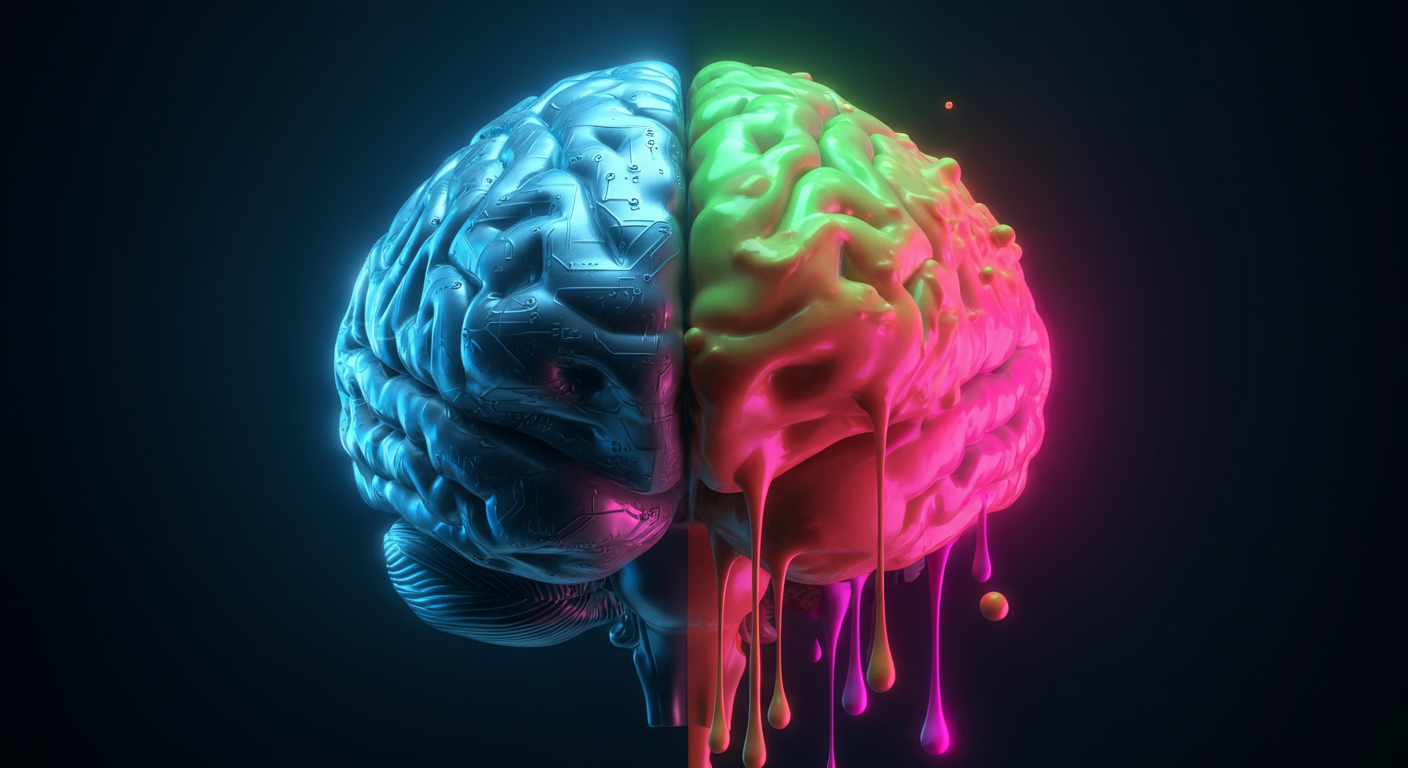
The 'Brain Rot' Attention Span Challenge
Can you stare at a static image for 60 seconds without your thumb twitching? If you failed, you aren’t broken.
You are just efficient.
According to Dr. Gloria Mark, the premier researcher in attention science, the average focus duration on a screen has crashed to a mere 47 seconds. That number usually triggers panic about a societal collapse into idiocy. We see kids staring at Skibidi Toilet and assume their brains are leaking out their ears.
But the hysteria surrounding "Brain Rot" ignores the mechanics under the hood. You aren't losing your mind. You are aggressively rejecting low-value data.
Stop fighting 'Brain Rot.' Your short attention span is actually a superpower.
The "Goldfish Myth" is dead. We aren't witnessing the death of attention; we are seeing the birth of "High-Speed Filtering." Here is the neurological proof that your inability to focus is actually your brain’s smartest defense mechanism.
The Evolutionary Logic: It’s Not Rot, It’s a Spam Filter
Let’s cut the melodrama. The narrative that TikTok is melting your prefrontal cortex into sludge is lazy fear-mongering. We don't have an attention deficit; we have a surplus of garbage.
ð Key Takeaways
- The Evolutionary Logic: It’s Not Rot, It’s a Spam Filter
- The Mechanics: Why You Can Binge Netflix but Can't Read an Email
- Insider Moves Most People Miss
Think of your attention like a bouncer at an overcrowded club. In 2004, the bouncer let people in slowly (2.5 minutes per screen). Today, the line is infinite, and everyone is shouting. If your brain spent 2.5 minutes analyzing every piece of content in your feed, you wouldn't be "focused"—you'd be catatonic.
Johann Hari, author of Stolen Focus, argues that this isn't a personal failure of willpower; it's an environmental response. Your brain isn't atrophying; it is aggressively budgeting energy against an infinite scroll of mediocrity. The uncomfortable reality? "Brain Rot" is just a high-speed spam filter developed by a generation drowning in noise.
Consider the Skibidi Toilet phenomenon. To a 40-year-old, it looks like nonsensical chaos. To a Gen Alpha user, it is hyper-dense surrealism processed at speeds that would fry a Boomer's neural circuits. The consumer's BS detector is now automated, and it runs on a sub-second loop.
The Mechanics: Why You Can Binge Netflix but Can't Read an Email
If we have "goldfish brains," why can we binge 10 hours of a Netflix series without blinking? This is the "Flow State Paradox."
The American Psychological Association (APA) has flagged the risks of social media on adolescent development, but the mechanism isn't simple distraction—it's the Dopamine Feedback Loop. Your brain hasn't lost the ability to focus; it has just raised the price of admission.
Platforms like YouTube Shorts and TikTok operate on a Variable Reward Schedule. This is the exact psychological trick used in slot machines. You pull the handle (swipe), and you don't know if you'll get a dud or a dopamine hit. Because the reward is unpredictable, you keep pulling.
When you try to switch from this high-octane environment to a boring work email, your brain revolts. It’s not that you can't read the email; it's that the email offers zero immediate chemical reward. You aren't distracted; you are bored. And in the attention economy, boredom feels like death.
The Center for Humane Technology describes this as a race to the bottom of the brain stem. Tech companies know that "High-Speed Filtering" is your defense, so they design algorithms to bypass the filter entirely. It’s an arms race between your willpower and a supercomputer. The computer is winning.
Insider Moves Most People Miss
Forget the standard "put your phone away" advice. That’s like telling an insomniac to "just sleep." To reclaim your brain, you need strategies that work with your neurology, not against it.
- Stop detoxing, start budgeting. "Digital Detoxes" usually fail because they rely on abstinence. Treat your attention like a bank account. Use apps like Opal to set a strict "expense limit" on high-cost apps (Instagram), while leaving "nutrient-dense" apps (Kindle, Audiobooks) uncapped. You don't starve yourself to get healthy; you just stop eating candy for dinner.
- Kill the "Second Screen." The most dangerous habit isn't the scrolling; it's Second Screening (watching TV while on your phone). This trains your brain that one stream of input is never enough. Force yourself to do one thing at a time. If the movie is boring, turn it off. Don't supplement it with a scroll.
- Gamify the exit. Algorithms use the Variable Reward Schedule to keep you doomscrolling because you never know if the next video is the one that hits. Break the loop by deciding the finish line before you start. "I will watch five videos, then I close the app." When you remove the infinity, you remove the addiction.
ð Worth Noting: But the hysteria surrounding "Brain Rot" ignores the mechanics under the hood