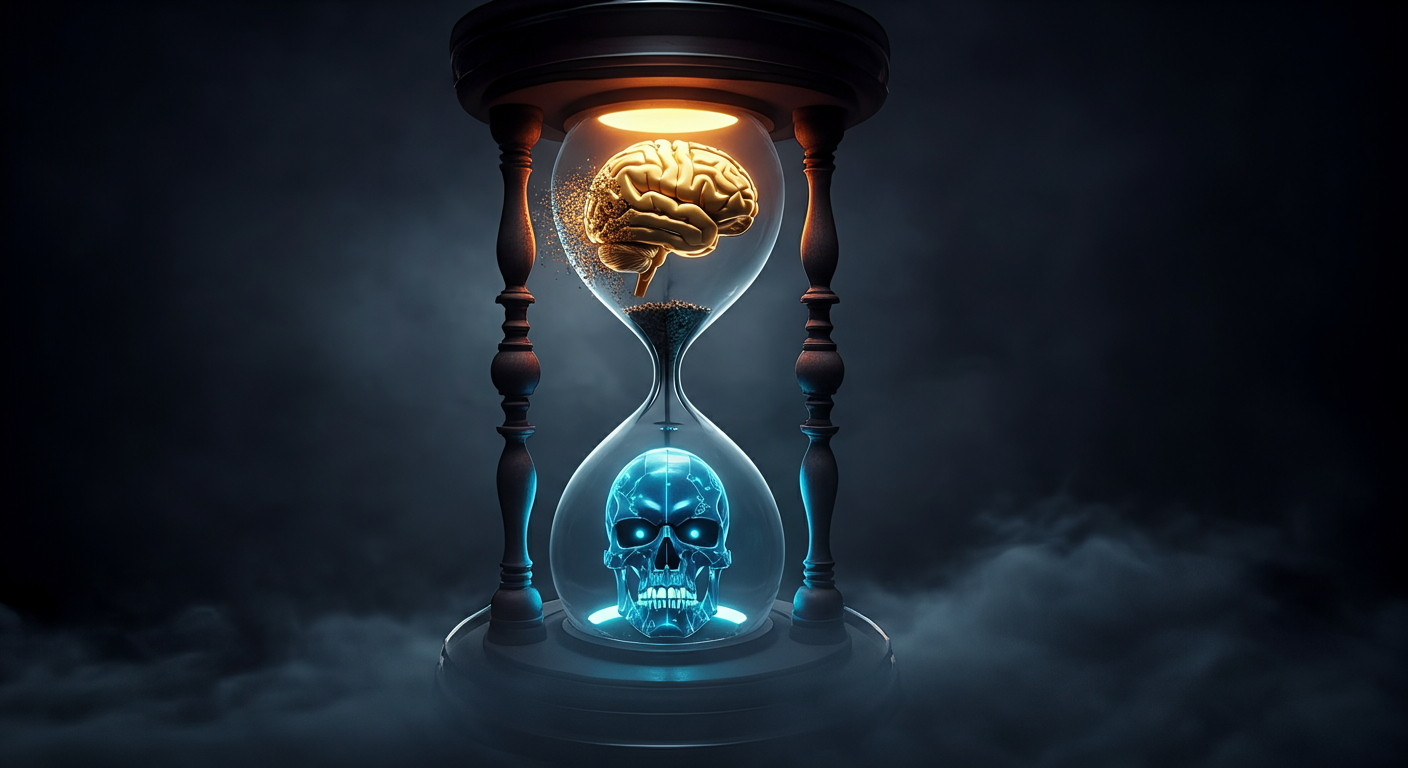
You want a date. You want to plug your job title into a calculator and see exactly which month in 2029 Ray Kurzweil’s prediction comes true and the algorithm takes your desk. It’s the only reason anyone reads about the "AI Obsolescence Countdown."
But the countdown is broken.
While the IMF screams that 40% of global employment is exposed and Goldman Sachs warns of 300 million jobs vanishing, they are calculating capability, not affordability. They assume computing power is infinite and free. It isn’t.
Stop worrying about GPT-5 being smarter than you. Start worrying about whether it’s cheaper to power than you. Currently, for any task requiring high-context reasoning, the answer is a hard "no."
Your brain runs on 20 watts—roughly the energy stored in a bagel. To match your output, an NVIDIA H100 cluster burns enough electricity to melt a credit card. This is the "Calorie vs. Watt" intersection, and it’s the only economic firewall keeping you employed.
The Watts-Per-Thought Ratio
Sam Altman keeps talking about the "transition" to Artificial General Intelligence (AGI) as a software hurdle. He’s lying—or at least omitting the messy hardware reality. The barrier isn’t code; it’s thermodynamics.
ð Key Takeaways
- The Watts-Per-Thought Ratio
- The Cost-to-Serve Economics
- How to Stay "Energy Efficient"
Here is the physics of your paycheck:
When Geoffrey Hinton left Google to warn us about AI surpassing human reasoning, he was talking about raw intelligence. He wasn't talking about the electric bill. A human brain operates on 20 watts. A single H100 GPU draws 700 watts. But AI doesn't think with one chip; it thinks with thousands.
To replicate the fluid, non-repetitive problem solving of a senior engineer, you need a cluster that consumes megawatts. This creates a "Thermal Ceiling." Silicon chips generate heat that requires massive industrial cooling. Your brain just needs a glass of water. This physical limitation is why MIT economist Daron Acemoglu predicts a meager 5.4% productivity boost over the next decade, contradicting the Silicon Valley hype machine. The tech works, but the unit economics are ruinous.
The Cost-to-Serve Economics
Let’s look at Devin, the AI software engineer from Cognition Labs. Impressive demo? Absolutely. But run the numbers on "Instrumental Convergence."
If you ask a junior dev to fix a bug, they eat a sandwich ($5) and fix it. If you ask an autonomous agent to fix it, the model enters a loop of reasoning, error-checking, and re-prompting. It burns through inference tokens like a drunk gambler. By the time the code is committed, the compute cost often exceeds the hourly rate of the human it replaced.
This is Moravec’s Paradox on steroids. High-level reasoning is computationally expensive. We are seeing a reversal of the "One-Shot Learning" advantage. You can show a human a new task once, and they get it. A model requires billions of examples via backpropagation to learn the same concept. That energy disparity is your safety net.
OpenAI knows this. It’s why they are desperate for fusion energy. Without a breakthrough in physics, the cost to replace you remains higher than the cost to employ you.
How to Stay "Energy Efficient"
Don't try to out-calculate the machine. You will lose. Instead, exploit the energy inefficiencies of silicon:
- Hoard "Small Data": LLMs need massive datasets to learn. Specializing in niche, undocumented, or analog workflows (where data is scarce) forces the AI to "hallucinate" or fail, making Human-in-the-loop (HITL) mandatory.
- Force Context Switching: GPUs hate switching tasks; they crave linear batches. Humans thrive on chaos. If your day involves jumping between angry client calls, creative strategy, and crisis management, you remain cheaper than the compute required to simulate that context switching.
- The Jevons Paradox Defense: Efficiency increases demand. As AI makes code cheaper, the demand for verified code explodes. Position yourself as the auditor, not the writer. The Post-Scarcity Economy isn't here yet; until then, verification is the bottleneck.
ð Worth Noting: " But the countdown is broken