Shrinkflation & Cost of Living Rage: The PPA Playbook Exposed
Go ahead. Upload today’s grocery receipt to a comparison tool. Check the total against what you paid for these exact items in 2019. The math isn't just depressing; it’s evidence of a psychological operation.
While 78% of Americans attribute inflation to corporate greed (2024 Harris Poll), most people still think companies shrink products to save money on wheat or aluminum. They don't. That excuse expired years ago. You are the target of a specific corporate strategy known as Price Pack Architecture (PPA).
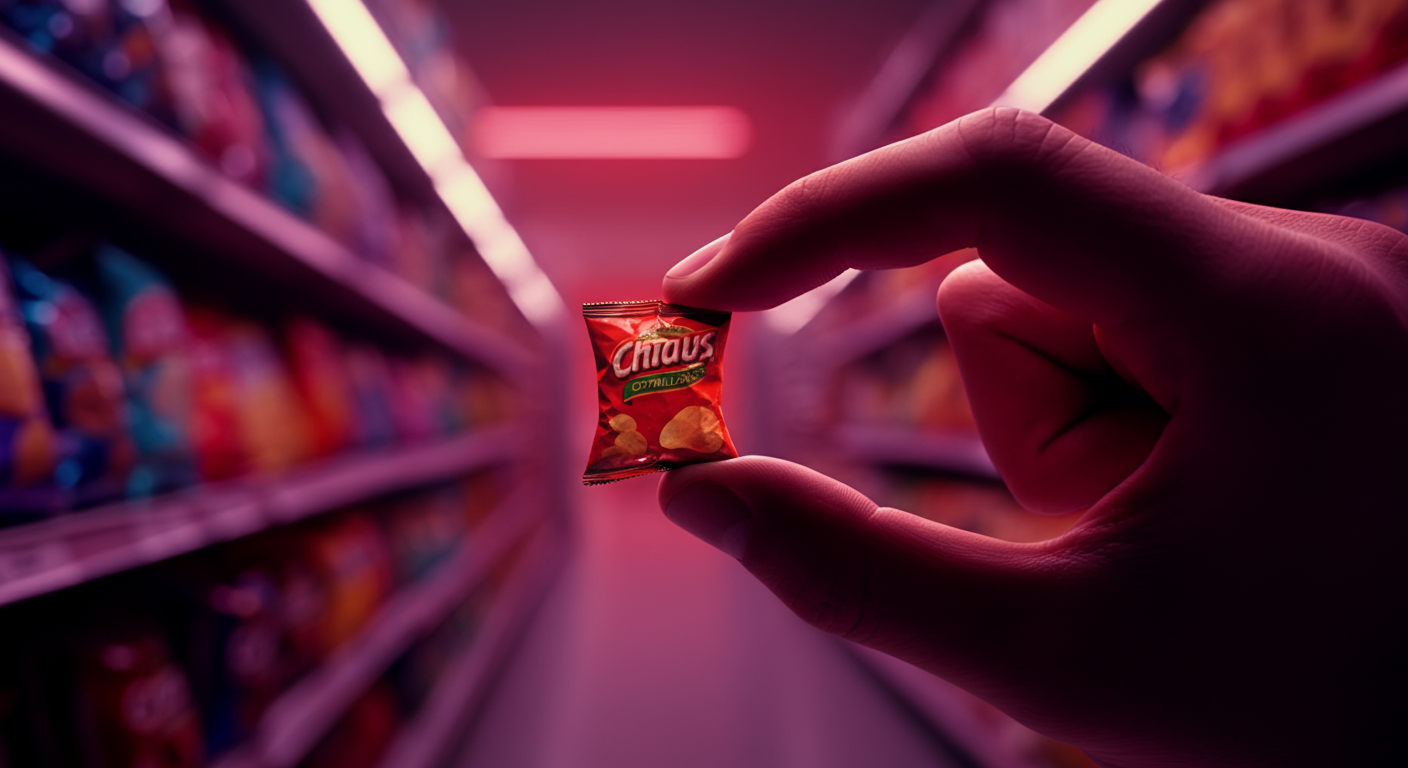
Inside conglomerates like Mondelez International, specialized "Revenue Growth Management" teams don't arbitrarily shrink your snacks. They rely on 19th-century psychophysics to hack your visual cortex. They aren't just cutting costs. They are selling you air.
The Science of "Just Noticeable Difference"
PPA teams operate with a single goal: margin retention. To achieve it, they weaponize Weber’s Law—a biological rule determining the "Just Noticeable Difference" (JND). Their algorithms calculate the exact percentage of mass they can strip from a package before your brain physically registers the loss. Usually, that threshold sits right at 9%.
If a 10% reduction triggers a sales drop, they cut 9% and curve the bottom of the jar. This is calculated deception. Companies use simulation software to redesign packaging curvature, ensuring "air-fill" masks the volume loss. It works because of Price Elasticity of Demand: data proves you are far more likely to walk away from a $0.50 price hike than a 1.5oz weight drop.
ð Key Takeaways
- The Science of "Just Noticeable Difference"
- The Detectives vs. The Algorithms
- Skimpflation and the "Greedflation" Fight
- Beat the PPA Algorithms
"We are witnessing a textbook case of sellers' inflation. Corporations with market power have discovered they can coordinate price hikes and size reductions to protect profits, passing the shock entirely to the consumer." — Isabella Weber, Economist, University of Massachusetts Amherst
This isn't a temporary glitch in the economy. It is a permanent recalibration of value. You aren't just paying more for less; you are the subject of a multi-billion dollar experiment designed to test exactly how little you are willing to accept.
The Detectives vs. The Algorithms
Since the packaging is designed to fool the naked eye, the only way to catch the cheat is through forensic accounting. Enter Edgar Dworsky, founder of Mouseprint.org. For decades, Dworsky has tracked these micro-aggressions, logging the slow erosion of net weight across every aisle in the supermarket.
His findings validate the rage boiling over on r/shrinkflation, where users post viral "before and after" photos of grocery discrepancies. But the data goes deeper than anecdotal photos. A combined analysis by Quartz and Consumer Reports (2023-2024) noted a massive 25% reduction in paper products. Toilet paper and paper towels are the primary victims because the "fluff" factor makes it easy to hide a loose roll.
To verify these changes yourself, you can't trust your memory. You need the Wayback Machine. By plugging in product URLs from Amazon or Walmart from two years ago, you can uncover the digital footprint of the old "Net Weight" before the PPA teams scrubbed it.
Skimpflation and the "Greedflation" Fight
When shrinking the package becomes too obvious, companies pivot to Skimpflation. This is distinct from shrinkflation; instead of reducing quantity, they degrade quality. They swap sunflower oil for palm oil, or reduce the cocoa content in chocolate, all while keeping the box size and price exactly the same. It's the silent killer of Grocery Bill Inflation.
The Bureau of Labor Statistics (BLS) struggles to capture this nuance in the Consumer Price Index (CPI), meaning official inflation numbers often underreport how much value you're actually losing. This disconnect has caught the attention of Washington.
Senator Bob Casey introduced the "Shrinkflation Prevention Act" to classify these deceptive packaging practices as unfair trade. The bill aims to force companies to label size reductions clearly, rather than hiding them behind a "New Look, Same Great Taste!" banner. Until that passes, however, the burden of proof is entirely on you.
Beat the PPA Algorithms
Corporations employ Revenue Growth Managers to calculate the biological threshold where your brain fails to register a size reduction. Here is how you outsmart their math.
ð Worth Noting: While 78% of Americans attribute inflation to corporate greed (2024 Harris Poll), most people still think companies shrink products to save money on wheat or aluminum
- Ignore the sticker price. The $5.99 tag is a psychological anchor. Your only metric is Unit Price (cost per ounce or gram). If the shelf label obscures this, use a Unit Price Calculator on your phone. You aren't buying a box; you are buying the mass inside it.
- Audit the "Net Weight." PPA teams use simulation software to add indentations to packaging, maintaining the visual volume while hollowing out the product. Ignore the box size. Read the bottom corner for "Net Wt."
- Watch the "Family Size" trap. Brands often introduce a "Party Size" that matches the weight of the old "Regular Size" but charges a premium. Always check the price per ounce to ensure the bulk buy is actually a deal.