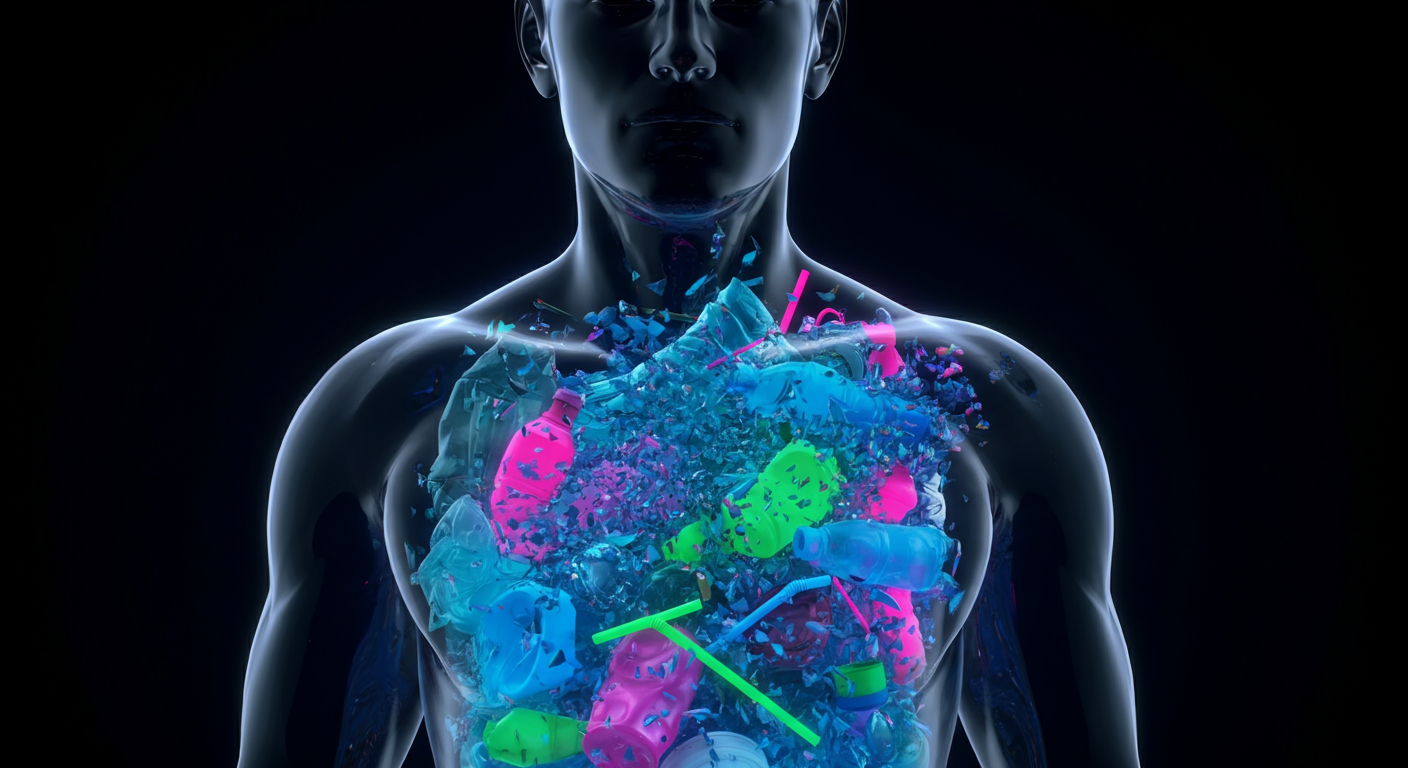
You are currently digesting a credit card.
That isn't a metaphor. The University of Newcastle estimates the average human ingests roughly 5 grams per week of polymer fragments. But swallowing plastic is one thing; absorbing it is another.
Prof. Dick Vethaak shattered the illusion of safety in 2022 when his landmark study confirmed microplastics in 77% of blood donors. These particles aren't just passing through your gut; they are circulating in your veins, lodging in lung tissue, and crossing the blood-brain barrier. Google this problem, and you will find endless articles telling you to buy glass Tupperware. That is prevention, not a cure. It does nothing for the polyethylene terephthalate (PET) already bioaccumulating in your liver.
You don't need another lecture on avoiding bottled water. You need an extraction protocol.
While regulators at the World Health Organization (WHO) rightfully call for more data before hitting the panic button, a quiet frontier of bio-hackers and hematologists isn't waiting. They are testing the "Bio-Excretion Protocol." From specific binder efficacy to therapeutic plasma exchange, we are tracking the first viable methods to physically scrub the chemosphere from your biology.
Here is how to get the plastic out.
ð Key Takeaways
- The Failure of Prevention: Why You Can't "Diet" This Away
- The Bio-Excretion Protocol: Breaking the Loop
- The Bio-Excretion Protocol: Insider Moves
The Failure of Prevention: Why You Can't "Diet" This Away
Let’s dispense with the pleasant fiction that buying a reusable water bottle is a health strategy. It’s a coping mechanism. The war for your biological integrity was lost years ago. While the middle class obsesses over BPA-free labels, the real threat has shrunk.
A 2024 Columbia University study obliterated previous assumptions by finding 240,000 nanoplastic fragments per liter of bottled water—particles so small they behave less like physical debris and more like dissolved gas. These nanoplastics bypass the gut lining entirely.
Dr. Antonio Ragusa proved just how permeable our barriers are with the "Plasticenta" study, detecting microplastics in human placentas. If the body cannot protect a fetus from polypropylene, your blood-brain barrier stands little chance. By the time you read this, those particles have undergone translocation—moving from your bloodstream into deep tissue.
The Plastic Soup Foundation argues that we are no longer just dealing with pollution, but a permanent internal "chemosphere." The liver’s natural filtration capacity is mathematically outmatched by environmental saturation. Your body is no longer a temple; it is a storage facility for PET.
The Bio-Excretion Protocol: Breaking the Loop
Most people assume that if they stop eating plastic, their body will naturally flush the rest. That is wrong. The human body struggles to eject these polymers due to a nasty biological trick called enterohepatic recirculation.
Your liver filters toxins from the blood and dumps them into bile to be excreted. However, without a specific binding agent in the intestines to "handcuff" these toxins, your gut simply reabsorbs the plasticizers (like phthalates) and sends them right back to the liver. It is a toxic feedback loop.
To interrupt this cycle, we look to clinical protocols used for persistent organic pollutants:
1. Genetic Susceptibility (The GSTM1 Factor)
Not everyone hoards plastic at the same rate. Individuals with null variants of the GSTM1 and GSTT1 genes lack the glutathione S-transferase enzymes necessary to conjugate and clear industrial chemicals. If you have this genetic variant (detectable via standard DNA health panels), your natural ability to clear plasticizers is severely compromised. You cannot rely on passive detox; you need active intervention.
2. The Binder Strategy
To stop re-absorption, you need agents with high affinity for polymer chains. Modified Citrus Pectin (MCP) and specific zeolites are currently being evaluated for their ability to bind to heavy metals and environmental toxins in the gut. The goal is to catch the plastic-laden bile before it recirculates.
ð Worth Noting: But swallowing plastic is one thing; absorbing it is another
3. The Nuclear Option: Therapeutic Plasma Exchange (TPE)
For cases of extreme bioaccumulation, we are seeing the theoretical application of Therapeutic Plasma Exchange (TPE). Validated by Vethaak’s findings that plastics circulate freely in blood serum, TPE separates plasma from blood cells, physically filtering out the polymer-laden fluid and replacing it with clean albumin.
While the National Institute of Environmental Health Sciences (NIEHS) is still funding the roadmap for toxicological research, blood donation studies regarding PFAS (forever chemicals) have already shown that regularly giving blood or plasma lowers serum levels of perfluoroalkyl substances by up to 30%. The logic holds: if the plastic is in the plasma, draining the plasma removes the plastic.
The Bio-Excretion Protocol: Insider Moves
Most advice stops at "don't drink from plastic bottles." That prevents future exposure, but it does nothing for the credit card’s worth of polymer already in your system. Here is the active removal checklist:
- Verify the Load: Don't guess. Pyrolysis-GC/MS or µFTIR are the gold-standard detection methods used in clinical studies to identify specific polymer types in tissue, though consumer access remains limited to high-end functional medicine clinics.
- Support Bile Flow: You cannot excrete what you cannot mobilize. Bitter herbs and phosphatidylcholine support bile flow, moving the trash out of the liver.
- Bind the Gut: Take a binder (Activated Charcoal or Modified Citrus Pectin) away from food to catch the toxin-laden bile in the intestine, preventing re-absorption.
- Plasma Donation: Regular blood or plasma donation is currently the only mechanical method available to the public to physically lower the volume of contaminated serum in circulation.