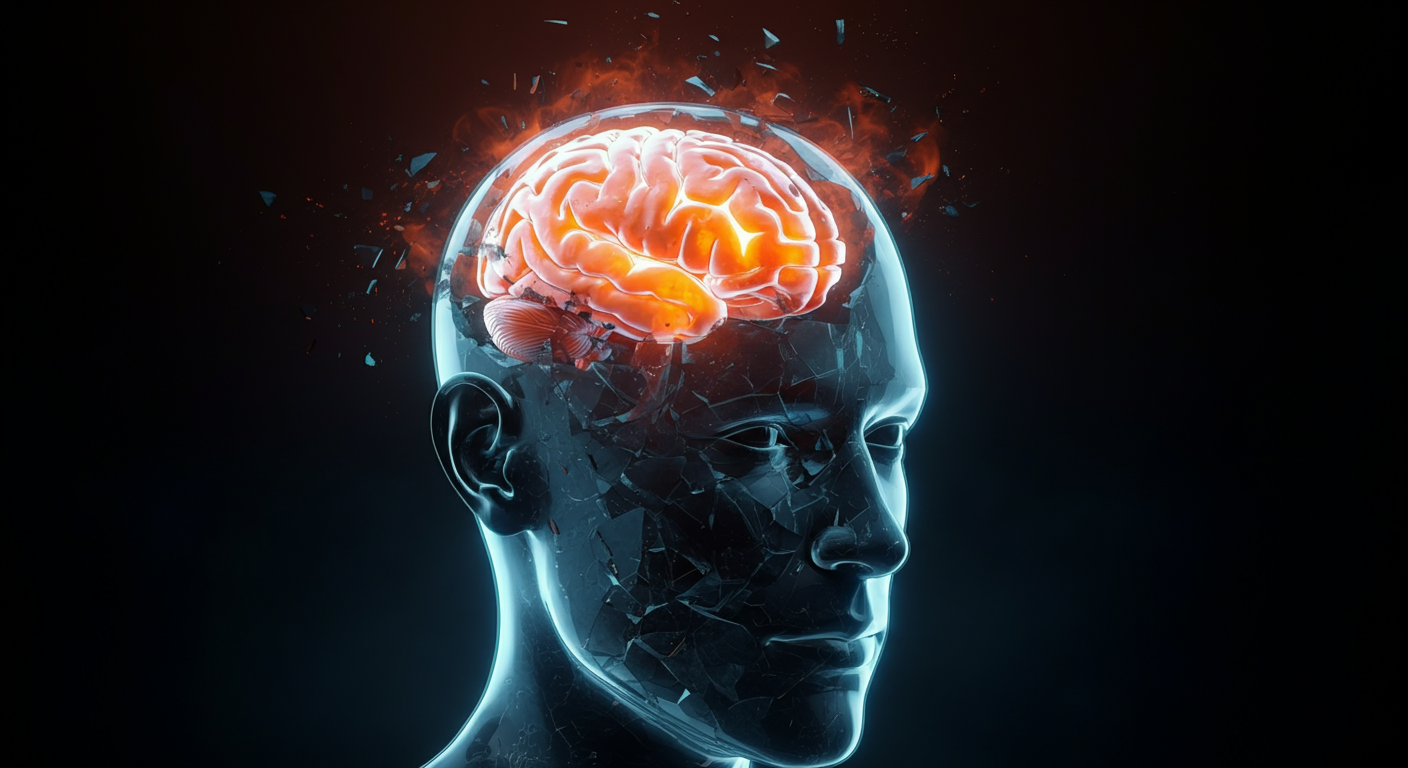
Digital Biological Age: Why Your Dopamine Fried Brain is 74 Years Old
You unlocked your phone to check an email. Twenty minutes later, you are watching a hydraulic press crush a watermelon, and the email is still unread.
This isn't a "focus" problem. It isn't a lack of willpower. It is a biological injury.
According to Stanford psychiatrist Dr. Anna Lembke, this relentless friction forces your nucleus accumbens to downregulate dopamine receptors. It chemically mimics the neural lethargy typically seen in geriatric patients. You might be twenty-five on your driver's license, but your reward system is showing signs of advanced decay.
Most competitors treat this as a productivity crisis. They are wrong. It is an existential one. The real cost isn't that you can't build a spreadsheet today; it's that you are biologically erasing your ability to imagine tomorrow.
Your calendar says you are young, but your neurotransmitters tell a different story. Before we fix it, we have to measure the damage.
The Framework: Calculate Your Digital Biological Age
We don't need a blood draw to estimate your "Cognitive Age." We can triangulate it using data you likely already have from a wearable like Oura or Whoop, combined with your screen habits. While the Horvath Clock measures cellular aging via DNA methylation, this framework measures the "wear and tear" on your nervous system.
ð Key Takeaways
- The Framework: Calculate Your Digital Biological Age
- The Mechanism: Temporal Myopia
- The Cellular Cost: Information Theory of Aging
- The Diagnostic: The 10-Year Horizon Test
- Insider Moves to Reverse the Rot
The Cognitive Age Calculator
Baseline Age: Start with your chronological age.
1. The HRV Penalty (+5 Years)
Check your Heart Rate Variability (HRV). Is your average during the workday >20% lower than your sleep baseline? This indicates high Allostatic Load—your nervous system is stuck in "fight or flight" due to digital micro-stressors.
2. The Loop Tax (+10 Years)
Check your Screen Time stats. Do you have more than 30 "pickups" per day? Frequent context switching fragments attention, mirroring the executive dysfunction of early-stage cognitive decline.
3. The Anhedonia Index (+8 Years)
Do low-stimulation activities (reading a book, walking without a podcast) feel physically painful or "boring"? This is Anhedonia, a hallmark of dopamine downregulation often found in the elderly or clinically depressed.
4. The Sleep Fragmentation Score (+7 Years)
Do you scroll within 15 minutes of sleep? Blue light suppresses melatonin, but the dopamine hit prevents the brain from entering the deep restorative states required to scrub beta-amyloid plaques.
If you checked three boxes, your "Digital Biological Age" is likely decades ahead of your birthday. You are running a 70-year-old operating system on 25-year-old hardware.
The Mechanism: Temporal Myopia
Why does this make you "old"? Because biologically, youth is defined by the ability to simulate the future.
When you flood the Nucleus Accumbens with cheap algorithmic rewards, you trigger a rapid downregulation of D2 receptors. Dr. Lembke identifies this as a deficit state, but the functional result is Temporal Myopia.
You are physically severing the neural connection between the striatum (reward) and the hippocampus (memory/imagination). This destroys "Episodic Future Thinking"—the cognitive function required to visualize, and therefore plan for, a future 10 years out.
Think about it. An organism nearing death biologically prioritizes immediate consumption. It has no need to plan for a decade it won't see. By training your brain to demand rewards now, you are chemically simulating the end of life.
We call this Dopaminergic Inflation. The brain discounts future rewards so steeply that a $10,000 return in a decade feels biologically less valuable than a red notification badge right now. It is effectively frontal lobe damage by design.
The Cellular Cost: Information Theory of Aging
This isn't just in your head; it's in your cells.
The body enters a Cortisol-Dopamine Loop. You scroll to soothe anxiety, but the information density spikes cortisol. This chronic stress accelerates Epigenetic Methylation.
Dr. David Sinclair, Professor of Genetics at Harvard Medical School, frames aging as a "loss of information." In this context, digital noise acts as extraneous epigenetic static. When your organism is stuck in a hyper-vigilant "now," it downregulates the longevity genes (sirtuins) required for long-term repair.
ð Worth Noting: You might be twenty-five on your driver's license, but your reward system is showing signs of advanced decay
Your screen addiction is driving your GrimAge—a mortality risk marker that ticks faster when your nervous system is stuck in chronic panic.
The Diagnostic: The 10-Year Horizon Test
Can you reverse it? First, you have to test your capacity for Episodic Future Thinking.
Close your eyes. Try to visualize your life exactly ten years from today. Not a vague idea of "rich and happy," but specific details. What does the coffee taste like? What is the texture of the chair you are sitting in? Who is in the room?
The Result:
- High Definition: Your dopamine pathways are healthy. You can delay gratification because the future feels real.
- The Gray Fog: If you see nothing, or just a blur, your brain has atrophied its simulation network. You are suffering from Temporal Myopia.
If you see the fog, willpower won't save you. You need to repair the hardware.
Insider Moves to Reverse the Rot
You cannot "think" your way out of a broken dopamine pathway. You must use environmental design to force recovery. Here is the protocol:
- Nuke the Morning Loop: Most people check notifications immediately upon waking, spiking cortisol and frying their reward system before 8 AM. Use Opal or strict Screen Time settings to hard-lock all apps until you’ve been awake for 60 minutes.
- Stop "Dopamine Stacking": Dr. Andrew Huberman warns against layering high-stimulation activities. Do not listen to music while scrolling Instagram while texting. Do one thing. Mono-tasking re-sensitizes your receptors.
- The "Boredom" Prescription: You need to feel Anhedonia to cure it. Schedule 20 minutes of zero-input time daily. No phone, no podcast, no meditation app. Just stare at a wall. This painful boredom signals the brain to upregulate receptors to find stimulation in subtle things again.
- Validate with InsideTracker: Don't guess. Track inflammation markers like hs-CRP. As you detox from digital stress, these markers should drop, proving you are reversing your biological age.
The "fried brain" feeling isn't permanent. Neuroplasticity works both ways. You can rewire your brain to enjoy low-dopamine activities again, but you have to stop feeding it the digital equivalent of high-fructose corn syrup.